Showing posts with label Midsummer Night's Dream. Show all posts

Thursday, September 25, 2014

Upcoming Shakespeare -- Fall / Winter 2014 (plus a little)

Oddly, its getting a bit thin out there for Shakespeare. But there is some... especially some college productions, which are happy on the budget! If you know of anything else going on in the next few months, please leave a comment! I get grumpy when I have to go too long without seeing live Shakespeare. ;-) (Some places don't have a schedule up yet... but I figured I should post these before I forget.)


2014
A Midsomer Night’s Dreame
Sept. 28, 1 p.m.

Twelfth Night
Oct. 23-25 and Oct. 30 – Nov. 1 at 7:30 p.m.
Nov. 2 at 2 p.m.

Much Ado About Nothing
Nov. 6,7,8, 14, 15, 16 
PCC

As You Like It
Nov.13 – Dec. 12

2015
Othello
May 21, 22, 23, 28, 29, 30  7:30 p.m.

Macbeth
Summer 2015
Portland Actors Ensemble

The Taming of the Shrew
Summer 2015
Portland Actors Ensemble


Wednesday, August 27, 2014

A Midsummer Night's Shtick


Wow! It's been a while since I've been on here. For one thing, I haven't seen a lot of Shakespeare lately. And the shows that I have seen, I've been too busy to review. Not good. I'd say I'm going to try to change that... but there's a surprising dearth of Shakespeare on the horizon -- strange, when the goal is to have productions of all 37 of Shakespeare's plays done in the next 2 years in Portland. Hmmm... Anyway... on to a review!

 
A Midsummer Night’s Dream
24 August 2014

PAE has a lot of practice doing outdoor summer Shakespeare, and it showed in their production of A Midsummer Night’s Dream. They did many things right – the actors poured themselves heart and soul into the production, and their enthusiasm spreads to the audience; they know how to handle the language so that it’s not awkward, even with all the rhyming couplets in Dream; and they are experts at doing theatre in an outdoor venue, projecting both their voices and their actions for large crowds and not depending on artificial amplification (I hadn’t realized till recently how unique this is!).

However, I have to say, I was disappointed in two major areas of this production.

First, there wasn’t any continuity in the fairy world.

There were adorable little fairies, played (very well!) by children, in fluffy tulle over white clothes and lush flower headpieces. Then there were three bizarre adult fairies in all black with bad attitudes and black bandanas. I really couldn’t see any reason for the adult fairies except to carry Titania’s bower on and off stage and to provide “music.” More on that anon. It would have made more sense if the adult fairies belonged to Oberon’s company and the children to Titania’s… but they all seem to be Titania’s… so I was left extremely confused about what they were there for and why they were so different from the others. Honestly, they were distracting.

Then there was Oberon – a grumpy satyr – which works, don’t get me wrong! But it doesn’t seem to fit in with the other fairies. He’s the only “mythical creature” fairy of the lot… and honestly, as great as his satyr costume was, it was left completely in the dust by Titania’s gorgeous purple and green dress… so much so that it was kind of hard to believe that he was the king of the fairy world with him as king.

And then, it saddens me to say, but Puck was all wrong. Not the acting – Kate Belden was marvelous, with just the right blend of mischievous and skeptical, and a brilliant physicality that really sold the part – but her costume was incomprehensible. A beige body suit that looked like a bored child had taken a sharpie to it – no real continuity or design or comprehensible reason for what was there – a corset and black tutu, face paint – again, in an incomprehensible design that looked like it was just there to fill space – and a bowler. OK… so some of the doodling on her body suit was supposed to look like Oberon’s tattoos and therefore show that she was his minion. But it looked more like sharpie doodling seriously. None of the other fairies had face paint or even heavy make-up. She didn’t look like she fit anywhere.

To me, this is a vision and continuity problem. There were a few too many ideas about what the fairies should be like, and the costumer and director tried to incorporate them all – sweet children flower fairies, almost Goth-ish (but they didn’t even go far enough to really be called Goth) dark fairies, semi-Steampunk Puck, mythical Oberon, and glitzy Titania. And with three other “worlds” in the play (the court, the lovers and the mechanicals), a highly diverse fairy world is just confusing and makes no sense.

My second disappointment in this production is a little harder to put into words because it’s a balance thing. I like physicality and energy and fun in a production… especially when the play calls for it. But I also feel that, as with everything, gags, physical humor, slapstick, etc. must enhance the text, not distract from it. And that’s where I feel this production fell down. At times the physical humor was so broad and all-encompassing that it detracted from the text. There were several times when I felt like the lines were just something they were getting through while they did their shtick.

Now, if you know anything about me or have read any of my other reviews, you know that the text is paramount in my opinion. When other aspects of the performance get in the way, when a concept or idea upstages the text instead of helping and enhancing it, I have problems. A Midsummer Night’s Dream just pushed the bounds too many times for me. From the introduction “rap” – and I hate to be quite so blunt here, but if you’re going to work a rap into something, first have a reason for it other than you’ve always wanted to do a rap, and second, please don’t have it done by a group of middle-aged white people; it was painful – to the strip-tease fight scene where the young lovers all lost their clothes; from the very strange “music” the dark fairies were “singing” to lull Titania to sleep, to a few too many pratfalls (especially when one of your main characters is wearing a short-ish skirt that just won’t stay down)…. It was too much. I lost the hilarity of Shakespeare in the shtick, and that’s just not fair to A Midsummer Night’s Dream, which is a wonderful play in its own right, funny and accessible and delightful even on the page. There’s no need to add the extras to “engage the audience” on this one. That shows that you don’t have a very high opinion of your audience and that you don’t trust the text to do what it’s been doing for 400+ years.

As Shakespeare pointed out in Hamlet's advice to the players, "And let those that play your clowns
speak no more than is set down for them. For there be of them that will themselves laugh, to set on some quantity of barren spectators to laugh too, though in the mean time some necessary question of the play be then to be considered. That's villanous and shows a most pitiful ambition in the fool that uses it" (Hamlet 3.2.1914-1919).

And that's amusing when you note that the one place the shtick and silliness didn’t feel out of place was with the Mechanicals… and that’s because basically everything they’re doing is ridiculous in the extreme already. As usual, they may have been my favorite part of the production. I kind of missed how I usually tear up at the end of Pyramus and Thisbe… but Bottom (Michael Godsey) tacked on a couple extra death scenes, and I got my tears after all from laughing so hard at him reenacting Romeo’s, Ophelia’s and Cleopatra’s last moments.

I do want to add that the acting was quite good. Patrick Cox is always fun to watch, no matter what part he has, and he did Oberon proud. The four lovers (Mariel Sierra, Tara Herschberger, Matthew Sunderland and David Bellis-Squires) were delightfully smitten with… whomever. And massive kudos again to Kate Belden who made me love Puck despite the train wreck of a costume.

Dream runs one more weekend – Aug. 30 – Sept. 1 – at Reed College. Performances start at 3.

Friday, August 9, 2013

Upcoming Shakespeare Summer 2013 to Summer 2014


Because I'm going to try to be better about making it to local Shakespeare, I've once again compiled a list of what's happening when. Many of the local colleges (MHCC, PCC, Reed, PSU, George Fox) don’t have their theatre schedule up on their web sites yet, but I'll try to update this closer to the beginning of the school year, if any of them are doing Shakespeare. (I'll also update this with links to my reviews... if and when I write them!)

And on a completely random note... how in the world are we getting so many productions of Cymbeline lately? In 2011, Northwest Classical did it... and then in 2012 Portland Center Stage... and now we have PAE and Oregon Shakespeare Festival and next spring University of Portland?!?! I'm not complaining -- I love Cymbeline! -- but for one of the lesser known plays, it's certainly getting a lot of attention!

The good news is that it looks like even without going to Ashland, there's quite a bit of Shakespeare this year. Not enough for one play a month (because there's a dry spell November through January), but otherwise, it looks like an interesting year. Maybe a little heavy on the tragedies... but oh well.

2013
Now – Aug. 24 
Romeo and JulietWillamette Shakespeare
My Review: Fun and Frustration in Romeo and Juliet

Now – Sept. 2 
CymbelinePAE

*Now – Oct. 11 
CymbelineOregon Shakespeare Festival

*Now – Oct. 13 
A Midsummer Night’s DreamOregon Shakespeare Festival

*Now – Nov. 3 
Taming of the ShrewOregon Shakespeare Festival

*Now – Nov. 3 
King LearOregon Shakespeare Festival

Aug. 17 – Sept. 29 

Aug. 17, 25, Sept. 29
Comedie of ErrorsOpsFest

Sept. 20 – Oct. 13
Richard III NWCTC 

2014
Feb. 28 – March 30
King LearNWCTC

April 5 – May 11 
OthelloPortland Center Stage

April 8 – 12 
CymbelineUniversity of Portland

May 23 – June 22 
MacbethNWCTC

May 23 – June 22 
Titus AndronicusPost5

Summer 2014 
Antony and CleopatraPAE 
A Midsummer Night's DreamPAE     

*Oregon Shakespeare Festival in Ashland (not quite local... but I feel compelled to include them because, I mean, it's Shakespeare!)


Thursday, January 31, 2013

A Year of Shakespeare

Looks like I need to do some dusting in here. I've been a little low on Shakespeare lately. But to fix that, I've got a plan for 2013: Read one Shakespeare play each month. It's not much... but it's a start. I've made a list -- originally this was going to be a reading / discussion group, but logistics haven't fallen into place yet. So I thought I'd just post my list, and anyone who was vaguely interested might read along with me.

If I'm diligent, I might post "things to look for while reading" for each play.

So here's my reading list. I realize that January is gone... but maybe you can sneak Macbeth into the beginning of February.


January              Macbeth                                              
February            The Taming of the Shrew
March                King Lear
April                  The Winter’s Tale
May                   Merchant of Venice
June                   Cymbeline
July                    Romeo and Juliet
August               As You Like It
September         Troilus and Cressida
October              Julius Caesar
November          A Midsummer Night’s Dream
December          Twelfth Night

If you are interested in reading along and maybe finding a way to discuss these (even with comments on here or via email?), leave me a note. By the way, a lot of these are ones happening in the Portland area this Spring / Summer (or in Ashland)... and I've tried to set it up so that you can read the play before going to see it. 

Sunday, July 15, 2012

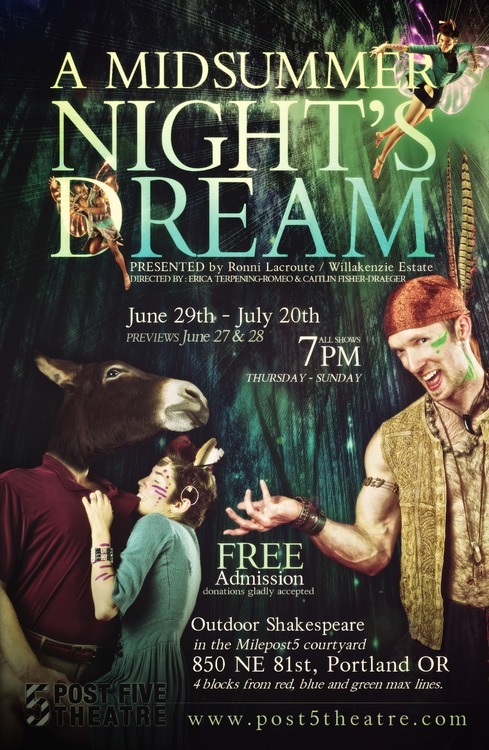
Post5's Dream


Review of Post5 Theatre’s A Midsummer Night’s Dream (13 July 2012)

The great thing about theatre is that no two perspectives on any one play are the same. Each production I see helps me understand the original better. Each director, designer and actor has his own view of what’s going on, and when you put those all together, you get a unique production that (as long as the perspectives are actually drawn from the script) helps the audience see the play in a way they never have before.

A Midsummer Night’s Dream seems particularly suited for this. Something about the play itself brings out the quirky creativity in people and lends itself to clever concepts and settings – sometimes a little too clever for the play’s good. But, honestly! What are you supposed to do with fairies, young people, courtiers and laborers-turned-thespians, not to mention magic spells and someone with a donkey’s head?

Post5 Theatre’s Dream took some getting used to. Directors Erica Terpening-Romeo and Caitlin Fisher-Draeger set it in Athens, Georgia, and gave everyone (all the mortals, at least) thick southern accents. Some of the actors handled this better than others, but overall I found I wasn’t a huge fan of listening to Shakespeare’s language with the extra challenge of sorting out an accent. (I’m not going to get into the discussion here of how English sounded in Shakespeare’s day. All I can say is, I didn’t live then.)

The other bit that I took a while to warm up to was their depiction of the fairies, who had some vaguely Native American vibe going on, complete with body paint and feathers. I will admit that the body paint (in fluorescent yellow, orange, green, pink and purple) was fun and funky, and they used it to good effect later on, but especially at the beginning, the fairies were a little too weird for me.

On the other hand, the way the directors had the fairies be present for the whole play, sometimes just watching on the sidelines, sometimes actively participating in bits where Shakespeare doesn’t explicitly have them on stage, was quite clever, and I liked it very much. They provided sound effects and contributed to the general enchantment of everyone else in the forest by occasionally smearing someone with pink or green paint – pink producing love and green envy or anger. While I’m pretty sure that Shakespeare is trying to point out that humans generally need little interference from the fairy world in order to make fools of ourselves, the fairy contribution to the insanity was a nice touch.

The set – a kind of scaffold supported by tree-like structures – provided handy perches for the fairies, and lent itself to some quite entertaining staging. It looked quite versatile, also – very impressive.

The costuming was problematic for me. The fairies wore as little as possible (low slung yoga pants and a bra?), and Helena and Hermia’s tops were inappropriately tight (Helena’s) and low (Hermia’s). That, coupled with over-the-top sexually suggestive physicality, keeps me from recommending the play. Don’t get me wrong: I know what’s going on in the play; I just think that it really doesn’t have to be that R-rated.

Orion Bradshaw’s Puck was a little disturbing at times until I started thinking of the fairy as a little boy who doesn’t know when something is appropriate and when not. From that point on, I enjoyed his performance very much.

The four lovers were quite good, and after a while, even the southern accents worked in this setting – especially with the girls. Jade Hobbs especially threw herself 110 percent into Helena, and did a marvelous job.

And then… the Rude Mechanicals. I nearly laughed myself sick when they were on stage. They were all quite brilliant, but especially Todd Hermanson as Bottom and R. David Willie as Flute. All the preparation for the play within a play was appropriately silly and great, but the play itself threatened to steal the show. From the Lion’s (Andrew Forrest’s) “mane” made out of a tutu to the Wall (David Wade Granmo) slowly melting under its own weight and Quince (Kerry Ryan) the director mouthing everyone’s parts along with them and correcting their pronunciation, it was amazing! And then, after all the silliness, they switched midstream and make the ending poignant and touching… Bravo.

I have yet to see a production of Dream that I am wholly satisfied with – no one’s vision is quite like mine – but each one I see helps me understand the play a little better, and for that, I am grateful. Post5 Theatre’s Dream may not be mine, but I think, under all the awkward accents, ill-conceived costumes and inappropriate actions, they caught the spirit and the heart of the play, as Puck says, “Lord what fools these mortals be.” Sometimes, it’s good to remember that… and to laugh at ourselves.

Tuesday, April 17, 2012

A Midsummer Night’s Nightmare

Review of University of Portland's A Midsummer Night's Dream, 13 April 2012

At the closing of A Midsummer Night’s Dream, Puck addresses the audience:

If we shadows have offended,
Think but this, and all is mended,
That you have but slumber'd here
While these visions did appear.
And this weak and idle theme,
No more yielding but a dream,
Gentles, do not reprehend:
if you pardon, we will mend:
And, as I am an honest Puck,
If we have unearned luck
Now to 'scape the serpent's tongue,
We will make amends ere long;
Else the Puck a liar call;
So, good night unto you all.
Give me your hands, if we be friends,
And Robin shall restore amends. (5.1.2275-2290)

Normally, when I hear this, I find myself thinking there’s no offense to mend, nothing to pardon, no amends to restore. It has been a happy dream, and I’m more than willing to extend my hands to Robin Goodfellow in friendship.

Not so at the University of Portland’s production of A Midsummer Night’s Dream. By the end, as much as I wished it possible, I was sure that no amount of pardoning could mend such an atrocity. I realize that this is a college production, and nowhere near in the same league as “professional” theatre… but even with that consideration, I give it a D-. I can’t remember seeing another play where I spent the first half wondering if I should stay for the second.

It would be one thing if it were just a play, poorly done, badly interpreted and ineptly staged. But this was the product of a college drama department, where students ought to be learning theatre skills and techniques – how to do things right, how to look and act appropriately to their parts and, most of all, how to be true to the script.

The purpose of all aspects of theatre is to advance the story and help the audience feel like they’re there, not to draw attention to themselves. Theatre is storytelling, and the minute we forget that is the minute we stop being true to the script. All departments would do well to remember this – costuming, make-up, lighting, sound, set design, and certainly the actors themselves. A drama program that neglects to teach its students this has grievously neglected their education.

Stage make-up, for example, is there mainly to make sure we can see the facial expressions of the actors under the lights. Oh sure, there are some characters whose make-up is part and parcel with their costuming – the odd scar here or there, the 1940’s glamour-girl make-up or, in this case, the fairies with their other-worldly face paint. And that’s fine, as long as it helps to define the character and stays true to the text. But that’s not the kind of make-up I’m talking about for the moment. The audience doesn’t want to see that the guys are wearing make-up. Deep down inside, we all know they are, but unless it’s part of their character (say, a clown or a cross-dresser), the make-up shouldn’t draw attention to itself.

It did. Distractingly. You see, not all stage make-up is created equal. And the amount of make-up you use for one venue and lighting scheme is different than the amount you use for another. This is what makes stage-make-up artists earn their living. Their job is to put just the right amount on so that the audience can see the facial expressions and the actors can look “normal” under the lights… but not more. I can see a drama department giving its students experience with a wide variety of types and styles of make-up… but if they don’t also give them the wisdom to know what is appropriate when, they’ve missed the mark.

Costuming, also, should enhance and help explain the characters. It should be consistent. It should look good on the stage. And it should have a reason for being the way it is. It is never OK to try something new with a costume just because you’ve always wanted to. It must help the story telling.

Megan La Fleur, senior at U. of P. and costume designer for Dream, has yet to learn this. Why in the world did she put Theseus (played by Clarke Orr, arguably one of the tallest people on that stage) in a suit coat with shoulders reminiscent of Lady Gaga or Romulans from the early 1990’s? They had no purpose, did not help define his character, and weren’t consistent. And it wasn’t like his entire world (because there are four worlds present in Dream) had the same look. He was the only one. And it looked weird.

She also needs to realize that it’s her job as costume designer to make sure that everyone’s costumes look right on the stage. Poor Cobweb’s costume was a pale yellow leotard with a black, sheer, cobwebby overlay, but under the stage lights she looked naked under the overlay. It was distracting and inappropriate. I’m guessing that in the costume shop it looked fine, but the costume designer’s job is to design for the theatre, not the costume shop.

I could go on, but I haven’t even come to the most problematic part: Puck. Whether the lion’s share of the blame goes to the director, Andrew Golla, or to the actress, Jessica Hillenbrand, is academic. But Puck was all wrong. From the moment she came on stage, I wondered if I had come to a strange mash-up of Midsummer Night’s Dream and Macbeth, because Hillenbrand was certainly channeling all three of the weird sisters, if nothing else. Her voice and physicality suggested pure evil, not a mischievous but good-hearted fairy. And if that wasn’t enough, she heaped on layers of completely inappropriate gestures – inappropriate to the play (because they didn’t go with her words at all, but distracted from them) and inappropriate to polite society in general (to my mind, at least, she was far across the line between physical and pornographic). Her best moments were when she dropped the act and stomped off stage in response to something Oberon told her to do.

If costuming and make-up, and indeed all aspects of theatre, should be drawn from the play itself and should enhance the story telling not detract from it, how much more, then, should the actors’ performances be drawn from the text. Hillenbrand’s wildly inaccurate and inappropriate representation of Puck was a huge distraction from the play itself. Puck is such a central character. Get him wrong, and practically the whole play is ruined.

I have to say “practically” because there were a few bright spots on the stage, even with everything that was so awful. The four young lovers – especially Helena (played by Eleanor Johnson) – were fairly well done. But then, Shakespeare is such genius, that no matter what you do with the two couples, it leads to hilarity.

The other bright spot was the Rude Mechanicals – especially Bottom (Charles Lattin). When they were on, I felt like I was finally seeing the play I had paid for.

But it wasn’t enough. The whole production was such a shambles that it was unredeemable, even though it was Shakespeare. And by that, I mean they used Shakespeare’s words… but they didn’t draw everything from the play itself, and that’s where they fell down. Drama is not license to do whatever you feel like, whether you are a costume designer, lighting tech, actor or even director. It’s a responsibility to be true to the play. And by doing a production like this, I feel that the drama department at University of Portland has let its students down. Perhaps they’ve gone through the steps and are working on their technical skills, but if all of that comes at the cost of actually producing the play whose text you are using, they’ve failed.