Showing posts with label Much Ado. Show all posts

Thursday, September 25, 2014

Upcoming Shakespeare -- Fall / Winter 2014 (plus a little)

Oddly, its getting a bit thin out there for Shakespeare. But there is some... especially some college productions, which are happy on the budget! If you know of anything else going on in the next few months, please leave a comment! I get grumpy when I have to go too long without seeing live Shakespeare. ;-) (Some places don't have a schedule up yet... but I figured I should post these before I forget.)


2014
A Midsomer Night’s Dreame
Sept. 28, 1 p.m.

Twelfth Night
Oct. 23-25 and Oct. 30 – Nov. 1 at 7:30 p.m.
Nov. 2 at 2 p.m.

Much Ado About Nothing
Nov. 6,7,8, 14, 15, 16 
PCC

As You Like It
Nov.13 – Dec. 12

2015
Othello
May 21, 22, 23, 28, 29, 30  7:30 p.m.

Macbeth
Summer 2015
Portland Actors Ensemble

The Taming of the Shrew
Summer 2015
Portland Actors Ensemble


Friday, March 8, 2013

Joss Whedon's Much Ado Trailer


After hearing rumors about Joss Whedon doing Much Ado About Nothing for a while, it's nice to know that it's actually happening! Look out, June! What do you think? What are you looking forward to the most about this? What are you dreading? (I will admit to being ridiculously excited about the casting! I mean... Nathan Fillion? Doing Shakespeare? Dogberry, no less? Yes, please!)

In random other news, I did read Shrew in February... and have been having troubles collecting my thoughts on it. Perhaps this weekend I'll try to pull some thoughts together.

In March I'm reading King Lear, one of my favorites.

So... nothing really profound... but I'm planning a trip to the Oregon Shakespeare Festival to see Shrew, Lear and My Fair Lady... so there should be some reviews happening when I get back from that.


Monday, August 6, 2012

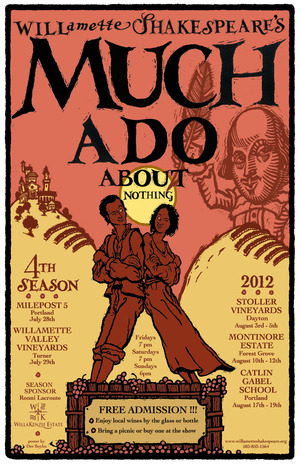
Not Much Ado


Review of Willamette Shakespeare’s Much Ado About Nothing (4 August 2012)

When Claudio asks Benedick what he thinks of Hero, Benedick replies, “Why, i' faith, methinks she's too low for a high praise, too brown for a fair praise and too little for a great praise: only this commendation I can afford her, that were she other than she is, she were unhandsome; and being no other but as she is, I do not like her” (1.1.167-172). In other words… she just doesn’t do it for me.
 
And that was exactly how I felt about Willamette Shakespeare’s Much Ado About Nothing. It’s hard to pin down what didn’t work for me. There were a lot of good things about the production, and yet, it fell flat.

Jason Maniccia was one of the highlights. His Benedick was solid, and he looked at home in the part. I could believe in all of Benedick’s changing moods – his self-confidence, his mockery, his frustration with Beatrice, his love-induced melancholy and his puppy love. My only disappointment was that he could have made so much more of the eavesdropping scene, but that is probably more director Daniel Somerfield’s fault.

Ithica Tell made a smart, sassy Beatrice. She made the 400-year-old puns and wordplays feel fresh and spontaneous and biting. But I could never really buy the bit where Beatrice is in love with Benedick. And unfortunately, most of the rest of the cast didn’t play up to her energy level, and so she felt out of place. I would really like to see her in some fast-paced, high-energy productions. I think she would be brilliant.

This production, however, was not fast-paced or high-energy.

Chris Ringkamp’s Claudio was eager and innocent and young and in love, but Holly Wigmore’s flat performance of Hero gave him nothing to work with. Where Chris really shone was as one of the watch, where he could play more of a comic role, and where the other actors’ energy was infectious.

Most of that energy came from Clara-Liis Hillier (Constable Dogberry) and Lauren Modica (Verges) who absolutely stole the show. Every moment they were on stage was a gem. Their timing, their expressions, the way they stayed so wonderfully in character when the focus was not necessarily on them – they were wonderful! And costume designer Clare Parker did a bang-up job with their costumes, too. I particularly loved Dogberry’s skunk necktie with the squeaker, and Verges’s fez.

Composer and musician Jason Okamoto also deserves praise for his beautiful music (performed by him and Ali Ippolito). It gave just the right flavor and helped create the mood where other aspects failed.

One of the main problems with this production was the timing. Was it really necessary to break up the flow of the whole thing by having stagehands rearrange the benches every scene? It didn’t contribute to the sense of location or setting, and it killed what little energy there was in the last scene. If the benches absolutely have to be moved, why not have the actors do it as part of their scene? Another timing issue was that actors would often do their actions and then speak their lines – but not at the same time. Guys? We’re not that interested in watching you play a game of lawn bowls. And when the play has a lot of talking in it, you don’t want to drag it out any more than necessary.

So timing was a problem. Lack of energy was a problem. Several poor performances contributed to the overall lack of sparkle. In general, I found it a good time to work on my quilt. Which is saying something on a 100-degree day.

Sunday, April 22, 2012

Much Ado About Surfboards


Review of Northwest Classical Theatre Company’s Much Ado About Nothing (20 April 2012)

One of the fun things about a theatre as small as the Shoebox is that the audience feels like they are actually in the setting, not just looking at it on the stage. Less than five minutes after I walked in to the palm-tree bedecked, 1960’s beach party themed theatre, I was wishing I had worn flip-flops instead of heels and a Hawaiian print instead of an LBD. (Bravo to director David Sikking for the amazing set design!)

Director David Sikking and the cast of Much Ado About Nothing certainly had fun with the setting – 1965 California beach, with surfboards, bikinis and the Beach Boys. And many things in the setting worked really well with the story. The party atmosphere that underlies Much Ado was obviously present. Don John (Orion Bradshaw) as a rebel without a cause actually makes perfect sense for one of Shakespeare’s enigmatic villains with very little motive for his actions. And the music (a mix of original songs by Stephen Alexander and classic surfer songs) made me want to sing along.

The fun, flirty dynamic between Beatrice (Melissa Whitney) and Benedick (Peter Schuyler) delighted me. Both actors made their characters’ arcs highly believable and consistent. And, as usual with Much Ado, the “eavesdropping” scenes made me laugh way too much! Benedick tried to hide behind the surfboards. And when that didn’t work, he tried to climb into the cooler, and then finally got his head stuck under one of the beach chairs. I didn’t think Beatrice’s scene could beat that, but when she hid under the beach umbrella, then collapsed it on herself, I was in stitches.

Hero (Brenan Dwyer) and Claudio (Carson Cook) made a sweet, young couple – just as they should be. Carson Cook, especially, rose to the challenge of a demanding part, and though his angst was somewhat understated, in the Shoebox it was very effective. There is a moment where we see “snapshots” of Hero and Claudio hanging out, surfing, playing games, and generally “dating.” It was priceless.

The whole production was highly physical, which had its great moments (Benedick turning around and nailing Beatrice with his surfboard, for one), but which also earned the production a PG-13 rating in my book. Don John and his minions (girls in this case, played by Clara-Liis Hillier and Jessi Walters) were too all-over-each-other for me.

The fact that Conrad and Borraccio turned into Connie and Veronica made for some awkward moments later on in the play, also… as did the fact that Clara-Liis Hillier played Connie in one scene and Margaret in the next. While Hillier is more than capable of handling multiple parts, it was unfortunate that those two parts were doubled. At least, I found it confusing… and I know the play quite well.

The setting, which worked well for many things (Gilligan meets Shakespeare?), turned out to be a complete disservice to Dogberry (Scot Carson). One would think that the part would be perfect – I mean, isn’t Dogberry a bit of a dumb surfer dude anyway? What’s the problem? The problem was that he didn’t stand out; he wasn’t that different from Benedick, Claudio, Don Pedro, Leonato, Antonio and the others. There wasn’t enough contrast, and without the contrast, the part just wasn’t as funny as it ought to have been.

Overall it was a fun experiment. I’m not positive that it was wholly successful… but it sure looked like a blast to put on!

Wednesday, April 11, 2012

One Reason I Love Shakespeare

I had a discussion with some of my students last week about why one should study Shakespeare. One asked for clarification in an email later, which gave me the chance to write this:

Shakespeare understood human nature -- what makes us tick -- and he wrote about it so well, that being familiar with his characters helps me understand the people around me. That's why his plays have survived 400+ years -- because deep down the people in the plays are the same people that we live with, that we work with, that we meet on the street or at the library.

Macbeth isn't really a story about witches -- it's a story about a man with ambitions and with a wife who pushes him to "succeed" no matter what it takes. He could be an executive, trying to be CEO of a Fortune 500 company, or a Senator aiming for the Presidency. And we see people like that in the news all the time.

Hamlet isn't just an emo kid who is commissioned by his father's ghost to revenge his (the father's) murder. Hamlet is a scholar, pushed into a world of action. But he's a thinker... and he finds himself paralyzed by thought. The "To be or not to be" soliloquy isn't about suicide -- it's about how thinking too much about which course of action we should take ends up keeping us from taking any action. I know people who are Hamlets in this sense -- they think and consider all the options and on and on and on... and things just don't ever get done around them... because it's always think first and make sure you've thought about it all.... Knowing Hamlet helps me realize that that's the way they think, and I can relate to them better because I've seen how Hamlet reacts when he's pushed into action (it doesn't go well).

Merchant of Venice is a story of the kind of loyalty you want in your friends -- and how important it is that your spouse and your friends get along, too. Merchant is such a beautiful story of friendship... it's almost a shame that it's clouded over with controversy about anti-Semitism (which isn't really in there... but a lot of people would debate that one).

Othello and Much Ado About Nothing are both warnings against believing everything you hear -- the tragedy (Othello) shows the horrible, horrible consequences, and the comedy (Much Ado) shows in what a tangled mess you can put yourselves and others if you don't verify rumors and accusations. And in this day and age where people are so quick to believe anything they read on the Internet, we could all use that reminder more often.

Henry IV is a coming of age story -- only here you have a dissolute prince who is having to deal with the consequences of his "sewing his wild oats" and become the kind of man he needs to be in order to be a good king. Those consequences (including having to abandon old friends and turn your back on the people who were closest to you) are quite painful and not easily dealt with. So this teaches me a couple things: (1) don't go there in the first place (personally), and (2) don't be quick to judge those who are having to clean up their act.


This is obviously just a smattering of examples. For the moment I've left out Lear, Julius Caesar, As You Like It, Twelfth Night, The Tempest and a whole passel of others. And Shakespeare isn't the only one who knows human nature and who expresses it in memorable ways. The reason he is one of the best, though, is that he created a massive cast of characters... so he has a wide range to explore. Not many people have that opportunity.

So that's one reason I love Shakespeare. One of many. What about you? Why do you love him?

Monday, March 12, 2012

Upcoming Shakespeare -- Updated with links to reviews

This list is for me as much as it is for anyone else. I'm trying to find a way to keep track of all the productions I want to see. People keep telling me that I should put all this in one place, so here are the upcoming productions of Shakespeare in the Portland area (at least, the ones I can find; if you know of others, please let me know!):


Cymbeline -- Portland Center Stage -- through April 8th. 
http://www.pcs.org/cymbeline/
I've already seen it once, and will see it again...
Here's my review of Cymbeline. 

Much Ado About Nothing -- Northwest Classical Theatre Company -- March 23 - April 22
My review of Much Ado can be found here.

A Midsummer Night's Dream -- University of Portland -- April 13-15, 19-21
Here's a link to my review of this production.

And then it appears there's a dearth of Shakespeare in May... but things really pick up in the summer.

Hamlet -- Portland Actors Ensemble -- June and July 2012
Here's my review.

Measure for Measure -- Northwest Classical Theatre Company -- June 22 - July 15
This is what I thought of it.

A Midsummer Night's Dream -- Post5 Theatre -- June 29 - July 20
My review is here.


Twelfth Night -- Portland Actors Ensemble -- July 21 - September 3
My review... with lots of deep, philosophical thoughts.

Much Ado About Nothing -- Willamette Shakespeare --July 28 - August 19
My review: Not Much Ado

Henry IV Part 1 -- Post5 Theatre -- August 17 - September 8
http://post5theatre.com/2012season
My Review: Princes and Theatre Groups Have to Grow Up


In November and December, Portland Center Stage is doing A Midsummer Night's Dream. http://www.pcs.org/blog/item/25th-anniversary-season-announced/

And I know there will be more announced later. :-)

Thursday, December 22, 2011

Review of Much Ado About Nothing with David Tennant and Catherine Tate

Epic win on the Christmas present front: my friends surprised me with a viewing of the Much Ado About Nothing "movie" last night. Complete and total surprise, because I didn't even know that it was released. But on to the review:

The first thing you should know is that it's set in the 1980s... which gets quite overpowering sometimes. The short shorts on guys, the stone-washed jeans, the obscene amount of pink on everything, the Lady Di reference, the Indiana Jones costume, the world's puffiest wedding dress, the Rubiks Cube, the cigarettes everywhere, the Thriller dancing, the cross-dressed costume... 'Nuf said.

David Tennant is brilliant as Benedick, of course. He handles Shakespeare's words so naturally that you forget that the language is supposed to be "old" and "hard to understand." (Side note: Shakespeare's language is not hard to understand or highbrow when done right... but with some actors you have an easier time remembering that than with others.) But perhaps his best moments comes when he pauses from the words themselves and just looks. The man speaks volumes with his facial expressions. He doesn't tend to go over the top, either. Benedick delivers one monologue entirely while sitting propped against a pillar with a soda (beer?) can and a funky straw. And it's brilliant.

Catherine Tate doesn't have a problem with the language either, but there are moments when her Beatrice lacks sparkle. She's good at the biting, sarcastic Beatrice of the beginning, but once she falls in love with Benedick, she starts acting rather Valley-Girl... which seems too young for her. As the story progresses and things start to get more serious, her Beatrice comes across like an emotional train wreck. In the scene where Benedick and Beatrice talk after Claudio has renounced Hero in front of the whole church, Beatrice goes from heartbroken and sad to giddy and girly when Benedick tells her he loves her, and then back to almost hysterically sad when she tells him to kill Claudio. To me, this feels more like the response of a 16-year-old than an adult. 

Even so, there are priceless moments with Catherine. Beatrice's "sick" scene -- where she comes to talk to Hero right before the wedding -- was hysterical. The sneezing every time someone said "Benedick" was perfect. And the bit towards the beginning when the Prince asks her to marry him is no end awkward, which is what it should be.

On top of all that, David Tennant and Catherine Tate obviously have chemistry. In their scenes together, their timing is delightful.

The best moment of the play (as seems to be the case with any production of Much Ado) is the bit where Benedick "overhears" the Prince, Claudio and Leonato talking about how much Beatrice loves him. The staging -- there's a rotating stage with three columns, and in this scene painters and buckets of paint -- was amazing. Benedick, while trying to listen in, ends up covered in paint, which is so amazingly funny that it almost detracts from the funniness of his lines at that part. But David, ever the showman, doesn't rush the lines. 

There are many other amazingly wonderful moments. But. But there's also enough costume issues and uncomfortably inappropriate bits that I can't recommend this to anyone, really. Catherine Tate always seems to be falling out of her top. At the costume party at the beginning, Benedick comes as... I don't know what. A hooker? Miss Piggy? It hides who he is all right, and as the audience you can totally believe that Beatrice didn't know who she was talking to... but I never really wanted to see David Tennant cross-dressing. The night before the wedding turns into a bachelor party and a bachelorette party, and even though they showed everything when Claudio "overhears Hero talking to a guy out her window," because of the setting, I wasn't convinced that there was enough motive there for Claudio's reaction. (My brain automatically went to "And the bachelor party was OK for you...?") (And because I'm trying to keep this blog family-friendly... I'm not even going to mention some of the other stuff.) Something else that could be a bit of a turn-off was the amount of "drinking" and "smoking" going on.

It's tragic that something with such potential has to be so raunchy. The casting for the whole thing is solid. Elliot Levey plays one of the best Don Johns I've ever seen -- totally believable, straight-laced, uptight, but a nasty piece of work. Claudio (Tom Bateman) is just the insecure, gullible type who would (a) fall in love with someone he doesn't know, (b) believe the worst of her, and (c) go off the deep end about it. John Ramm makes a great Dogberry, although the officers of the watch almost outshine him at times.

Here's hoping that someday good actors will do Shakespeare brilliantly without all the added junk. It can be done, and it should be done. Shakespeare deserves it.

Sunday, August 14, 2011

Review of Portland Actors Ensemble’s Much Ado About Nothing (13 August 2011)

I was very thankful intermission came when it did. My cheeks hurt from smiling and laughing. And then, after intermission Master Constable Dogberry came on… and my cheeks hurt again.

This is Portland Actors Ensemble’s 42nd season, and seeing Much Ado About Nothing gives you a hint about why the group has been around so long. They obviously love what they do, and they do it very well.

Director Asae Dean set the play in Napoleonic times, as evidenced by the empire-wasted dresses and Master Constable Dogberry’s fantastic hat and coat. Despite the play’s more serious side, Dean has made sure the action moves right along and the humor is never far away. Just when our hearts are about to break for Claudio as he discovers the truth about Hero, Master Constable Dogberry chimes in with a reminder that he is “an ass.” Or when Leonato challenges Claudio to a duel, Antonio (Leonato’s brother, hysterically played by Patrick J. Cox) goes overboard attacking Claudio with his cane, and we can’t help but laugh.

There are so many good performances in this production that it is impossible to list them all. Sara Fay Goldman plays Hero, and plays her very well. But where she really shines is as Master Constable Dogberry, leading his watch of Keystone Cops, who look like they would be very much at home in the Pirates of Penzance. Goldman’s over-sized gestures and expressions could make the part funny, even without Dogberry’s mixed-up vocabulary, but together they are brilliant. Racheal Joy Erickson’s Beatrice is delightful. She is witty, but not too biting, smart and sassy, but also sweet and loveable. Arthur Delaney throws himself into the role of Claudio 110 percent. Jenny Newbry Waters plays Don Pedro’s brother, Don John, with marvelous intensity and villainy. And Patrick J. Cox’s little old man Antonio threatens to steal the scene every time.

The sets are quite minimalistic, but that doesn’t detract at all from the performance. The latticework trellises and folding chairs are simple but ample. My favorite sets, however, were the “trees” made out of green umbrellas adorned with lemons and leaves, and held by two of the actors. Brilliant!

Possibly the only drawback of this wonderful production is that the music is a bit rough. But when everything else shines so brightly, we can perhaps pardon a slightly-less-than-stellar song or two. Besides, conditions in the parks are not entirely favorable to music, and not everyone is comfortable singing a cappella.


Much Ado About Nothing runs through Labor Day weekend, and it’s only getting better. (The few rough edges I saw opening weekend were completely gone two weeks later.) Go see it, if you possibly can. It’s a wonderful afternoon of theater absolutely free. For dates and locations, visit www.portlandactors.com.