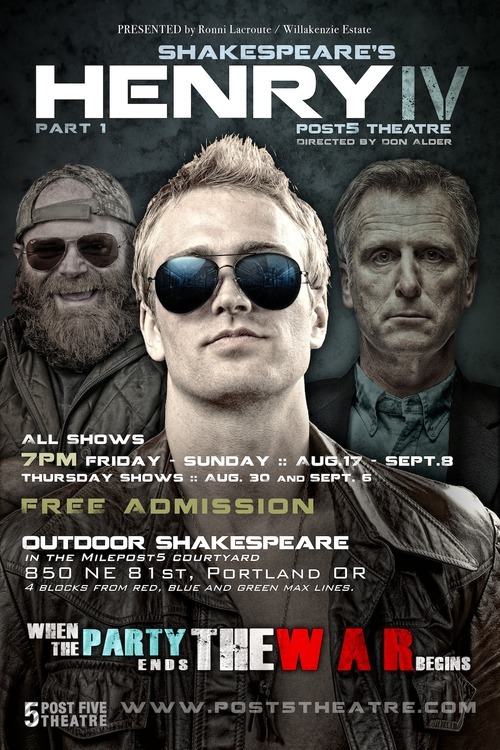
Review of Post5 Theatre’s Henry IV Part 1 (31 August 2012)
Perhaps I’m more of an English Prof than a Theatre Critic. My first criteria
when looking at a play is not “How well did this production hold together?” or “How
well did the actors bring life to their characters?” or “How entertaining was
this?” but “How well does this production adhere to the text?”
I realize that your Joe Blow Theater Patron couldn’t really
care less about the text, seeing it – if he sees it at all – as only the
backdrop to an entertaining evening out.
But especially where Shakespeare is concerned, messing with
the text bothers me every time. Why? Because Shakespeare worked hard to make
his plays “hold, as 'twere, the mirror up to nature; to show Virtue her own
feature, scorn her own image, and the very age and body of the time his form
and pressure.” He carefully crafted his words, characters and scenes to get at
something specific. And when that is ignored, or worse still, deliberately
altered, a great disservice is done to the play, the audience and even the
actors.
Now, don’t get me wrong – I realize that there’s a lot of
room for interpretation and individuality when producing Shakespeare. So I’m
not at all bothered by variant readings or alternate views of a play. But when
one’s concept or one’s own ideas about how things could be done trump the text,
that’s where I draw the line.
And that’s what bothered me the most about Post5 Theatre’s Henry IV Part 1 – it messed with the
text, and because of that, missed the whole point of the play. Subtly (but
deliberately, because you can’t switch the order of scenes around without doing
it on purpose) they shifted the focus from Prince Hal to Falstaff… and instead
of a Growing Up and Taking Responsibility Story, it became so much less. The
new “final scene” (they ended with Act V Scene 4 instead of 5) left me feeling
like the take-away was “Living a debauched life isn’t so bad as long as you
know the right people and are in the right place at the right time” – although I
will say that I don’t feel like the entire show backed that point up.
The problem is that the ending of anything is extremely
important. In a play, it’s the last thing the audience sees. It’s the image
that sticks with them. Shakespeare started and ended the play with the King
(Henry IV) speaking, and I think it’s significant that the last voice we hear is
Hal’s father accepting him and finally giving him the respect and responsibility
that belongs to a prince. You miss all that when Falstaff gets the last word,
and it isn’t a sincere one.
The very modern, rather American setting also contributed to
the obfuscation of Shakespeare’s point. I lost any sense of royalty, of the
fate of the nation hanging in the balance. And giving Henry IV the feel of a
president instead of a king diminished the importance of the worthiness of the
heir to the throne. Presidents don’t pass their office on to their oldest sons.
In fact, as the play went on, I grew more and more convinced that this wasn’t
about kings, but about crime lords or rival gangs. The ubiquity of the biker
theme didn’t help this at all.
Why should Hal grow up and set aside his “friendships” with
his biker buddies? Why should he clean up his act and stop all the drinking,
drugs and debauchery? What’s the incentive? I got absolutely no sense of “someday
you will be king, and you need to start acting like one.” In fact, when Henry
IV is dressing Hal down in what should
be a very moving scene and a definite turning point in the play, the king pulls
out a bottle of Johnny Walker and starts drinking. Maybe I’m too picky, but my
first thought was, “Double standards much?”
The overriding thought behind this
production seemed to be (in my humble opinion), “We, the cast and crew, are
going to have fun!” Great. I have nothing wrong with that. I have often dreamed
of doing theatre, first and foremost because it looks like so much fun. But
that fun must be tempered by the text. You have to have some reason for doing
something other than, “It’s fun.” When you start making decisions based on what
would be “fun,” you always have to double check them against the text.
Sure, to some people it might be a
lot of fun to portray the Douglas (Samuel Dinkowitz) as the head of a
biker gang. But in doing so, you lose the idea that he represents the power of Scotland, which, last time I checked, is
a little more than just a biker gang.
In this same vein, I found the
extra-textual asides (random modern non-Shakespearean insertions) amusing at
first, but they quickly got tedious and detracted from the beauty of the
language. While it might be fun to put them in, is it worth the constant
reminders to the audience that Shakespeare’s language isn’t the same as today’s?
Shouldn’t you be trying to help the audience feel at home in the language and
forget that it’s different?
I don’t blame any of this on the actors at all. In fact,
much of the acting was superb. Orion Bradshaw’s Hotspur was fiery and impetuous
and so intense it was almost frightening… when it wasn’t funny. Brenan Dwyer
played up to him as Lady Percy and complemented his passion nobly. Phillip J.
Bernes was marvelous as Francis the drug dealer, but even more impressive as
John of Lancaster – a bit part, but an important one. Michael Godsey was
thoroughly conniving and evil as Worcester, making Hotspurs passionate
rebellion look almost innocent by comparison with his own cold-blooded, calculating
villainy. Jeff Gorham made a respectable King (or President?) Henry IV and brought
an air of maturity and gravity to his part.
I save Ty Boice’s Prince Hal for last because, though he did
an excellent job, he just wasn’t quite able to assert his presence over that of
Falstaff (Rusty Tennant). Again, it felt like
the “let’s have fun with this” mentality won out over the text, because
Falstaff just turned into so huge a presence that Hal’s part was necessarily diminished.
This is possibly the genesis of the
question of who the play is really about and the muddling of Shakespeare’s
point. There is a delicate balance between Hal and Falstaff as characters. Get
that out of alignment, and the whole play shifts.
The problems I have with this
production come more from how the play was conceived by director Don Alder (and
possibly by the vision of Post5 Theatre in general?) than from individual
performance (with the possible exception of Tennant’s Falstaff). And maybe I’m
being overly critical of the whole thing. I doubt many people even realized
that the production missed the whole point of the play. But isn’t that even more
reason to uphold the text? Don’t you have a responsibility to your audience to
give as accurate a representation of the play as you can?
Post5 Theatre reminds me a lot of Prince Hal, actually: They have a responsibility – a responsibility both
to their audiences and to the plays themselves. They also have a lot of
potential to be able to fulfill those responsibilities. But until they stop doing
things “just for fun” and start giving the texts the respect they deserve, they will
not be major players in the theatre world.